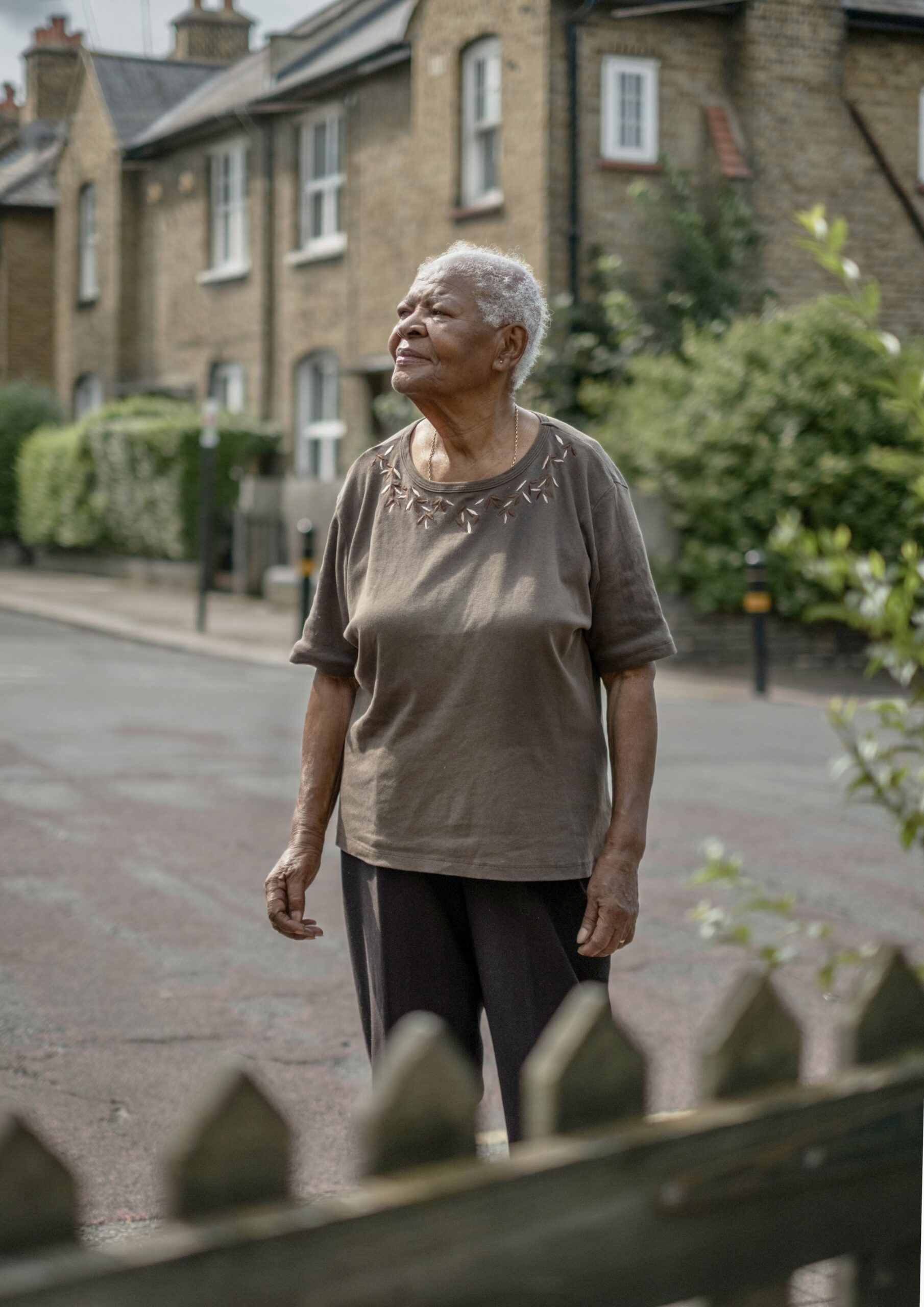
PRINCESS AKA ‘BLOSSOM

Princess Aldridge, AKA Blossom, was born in Trelawny in the Jamaican countryside in 1933
Her dad grew yams, bananas, cocoa, 'dasheen' (Taro plant), and another root vegetable, 'tyre'.
Her parents had children from previous partners, so Blossom had a big family with many siblings and step-siblings.
One of her earliest memories is being around four and starting at 'Quatty School', where you pay the teacher a penny-halfpenny weekly for lessons. (Quatty comes from the fact that a penny-halfpenny is a quarter of a Sixpence)
Her parents sent her there to get her education going before proper school started at seven years old.
She walked to school on rough stone roads; there was no tarmac back then. She enjoyed school, and just one teacher taught everything from arithmetic to gardening.
Around the time she finished school, her mum suddenly passed away. She had previously hit her head, which affected her blood pressure, and she died sometime after the accident.
At the time, this never really sunk in for Blossom - she thought her mum had just gone away to another country. There was no such thing as an undertaker - you died on one day and were buried the next. It was all so sudden that it didn't feel real to the 16-year-old.
At her first job, she learnt embroidery. She could hand sew and use the machine but couldn't get into dressmaking. She left this job and went to Kingston to work as a domestic for a couple from the Cayman Islands, looking after their new baby.
One of Blossom's most vivid memories of Kingston is sneaking into the grounds of Kings House to see Princess Margaret, who was staying there while on a tour of the Caribbean. There was no security then, so Blossom and her friends crept under the fence and into the compound to get a better view.
When her employers decided to return to the Cayman Islands, they asked Blossom to accompany them. Blossom decided against this, so she had to find a new job.
She went to see one of her older brothers who lived in the district of St Thomas to the East of Jamaica. It was through her brother that she met Solomon, who was known as Mike (Many West Indian people have a nickname). She remembers that it was all down to eye contact - they knew immediately that they liked each other.
Mike was a shoemaker, and he had a room in a house near the church in a small community, and Blossom moved in with Mike.
Nobody had a problem with them living together before marriage, but Blossom needed to find work. A few kids were running around, and the pastor permitted her to set up a school in the church. It was sixpence a week, and she had about six kids in her class.
Mike saw the adverts in the Jamaican Gleaner encouraging young people to come to England. And in 1956, he decided to go.
Blossom was due to see him off at the dock but discovered her dad was gravely ill. She said goodbye to Mike and hitch-hiked back to her district on a market truck.
When she got to the hospital, her dad looked so sick that she barely recognised him. He was only 54. He'd had a hernia operation, and the surgeon had left a piece of equipment inside him. In those days, there wasn't a nurse that counted all the tools in and out, and this error caused him to get an infection. He died the following morning, but at least Blossom got to see him one last time.
Blossom continued teaching until Mike wrote, saying that he had a place to stay in London and had found her a job and that she should get a passport and come. In 1957 Blossom boarded The SS Venezuela for the UK.
Mike and his sister were waiting for her at Victoria Station, and luckily, they had a coat for her. It was March, and it was foggy. At 23, this was the first time in her life that Blossom had ever experienced feeling cold.
As they left the station, she looked around and wondered where all the houses were. She thought the houses were factories because of all the chimneys belching smoke from the coal fires. There are no chimneys in Jamaica. For a while, she even thought the chimneys were canons pointing at the sky.
Mike had rented a room at 3 Lammermoor Road in Balham from a West Indian landlord called Mr Robinson. It was just a room with a paraffin heater. There was no carpet, just Lino on the floor.
You had to put a coin in the meter for electricity, and if you wanted a bath or a shower, you had to go to Tooting Baths, where you were only allowed 15 minutes. This was a surprise to Blossom. The adverts about England said the streets were paved with gold, and she wasn't expecting to live in such conditions. Back in Jamaica, Blossom's house was spacious and had its own bathroom. Despite this, being in London and seeing Mike again after their year apart was exciting.
The next day Blossom and Mike took the 155 bus to Colliers Wood to the factory where Mike was already working. The factory worked in metal and made rough components for items like toasters or irons. Once the parts were made, they were sent to another factory for finishing and then would go to another to be made into the final items.
Blossom worked on all sorts of things on the production line and, most of the time had no idea what she was making. She remembers having to weld a small bowl onto a metal plate. Years later, back in Jamaica, she went to church and saw a communion bowl welded into the middle of a plate. It was only upon seeing it all polished up that she finally realised what she had been making all those years before.
It was very hot in the factory, and Blossom had to wear leather gloves to protect her hands against the sharp, rough metal. She worked in the women's section on smaller items, whereas Mike worked in the men's area on larger and heavier products.
During this time, Blossom made a lot of friends. This was before they had children, so the couple often went out. They loved the cinema, and Blossom remembers watching ‘Ben-Hur' at the Classic Cinema in Balham. They paid a shilling to get in.
In 1958 the couple married in Ramsden Road Baptist Church.
They wanted to start a family, but Blossom said that there was no way that she was having babies in a single room, so they looked for flats in the Local paper.
A Self-contained flat was going for £2.50 per week in Louseiville Road, Balham. A Polish couple owned it. Blossom was very well-spoken on the telephone, and she called her potential landlady. They had a pleasant chat and arranged to view the flat that afternoon.
As soon as Blossom got there, the landlady took one look at her and said the flat was gone. Blossom looked her in the eye and said, 'It's not gone; it's because I'm coloured' (In those days, it was common practice to use the now offensive term coloured). The woman had no answer for Blossom; she just shut the door, and Blossom and Mike had to find somewhere else to live.
The same thing happened not long after when Blossom phoned up about a job. She was virtually offered the job after talking on the telephone, but when the boss saw her in the flesh, he said the job had gone.
Eventually, the couple found somewhere to live. By then, Blossom worked as an orderly at The Fountain Hospital in Tooting. (Now the huge St George's teaching hospital). Mike was working as a carpenter, making furniture in a factory where he continued to work until he retired. He also did the sound systems at "House to House" parties which bought in a little extra cash. Blossom would always go to the parties, "It was nice, people you know. It was soft music. No fighting, no knives, everyone dressed up smart."
In 1961 Blossom had her first baby, a boy called Ken, at the Weir Maternity Hospital in Balham (Now a Travis Perkins). She shared a bathroom with two white girls who were also heavily pregnant.
Whenever Blossom had a bath, the pair kept coming into the bathroom to try and look at Blossom's behind to see if she had a tail. In those days, some white people thought that black people had tails. Blossom, who doesn't take nonsense from anyone, wasted no time showing them otherwise by waving her behind in their faces.
Blossom and Mike then had two daughters, Yvonne and Carol.
During this time, Blossom worked nights as an auxiliary nurse. She worked in the geriatric ward, writing reports on the patients - how they slept, if they'd taken any medication, etc. When she got home from work in the morning, Mike, who had been watching the kids, would be getting ready for work.
By then, the landlord said the babies were making too much noise, so she applied for a mortgage from Nationwide, and they got a deposit together using the Pardner scheme. The Pardner scheme originated in Jamaica and involves a group of friends or relatives putting money into a shared pot to pay for large items like cars or house deposits.
The house they bought was in Letchworth Street, Tooting.
Meanwhile, the matron at the hospital was impressed with Blossom's work. She encouraged her to go beyond being an auxiliary and applied to the School of Nursing on Blossom's behalf.
Of the five women who applied then, Blossom was the only one who passed the test. She became a student nurse in 1972
Once she qualified in 1974, Blossom was one of the first nurses to work at the newly opened Charing Cross Hospital in Hammersmith. She worked there until her retirement in 1993.
Blossom was still experiencing racism in the hospital environment.
She remembers getting the bus to work at the hospital. A white woman was sitting next to her. She asked all the other passengers around her if she was going the right way to the hospital. She refused to talk to or even acknowledge Blossom.
Not long after Blossom got to work, the same woman arrived. She was visiting her husband, who Blossom happened to be caring for. The woman recognised Blossom immediately, and there was an awkward silence before Blossom said, "If you'd just spoken to me on the bus, I could have taken you straight to him."
On another occasion, a patient from South Africa was at the hospital. This was during apartheid, and the woman was extremely rude to Blossom.
Blossom noted that during the woman's operation, the nurses, the porter and the doctors who cared for her were all black.
When she came around from the anaesthetic, Blossom said to the woman, "See, we didn't kill you. We helped you." Blossom was pleased to see that the woman's attitude changed after this experience.
In Blossom's words regarding racism, "We tolerate it. I didn't pay them any mind. We meet hell, but things will get better one day at a time."
In 1981 after 20 years of marriage. Blossom and Mark divorced.
Blossom continued to work as a nurse, and some years later, she married Roy. He was also from Jamaica and, like Mike, was also a carpenter. She knew him from the house parties back when she was young. By then, Blossom was in her 50s.
After retiring, the couple decided to move back to Jamaica. It was Roy's idea to go back; he had had enough of the cold British weather. Blossom had lived in London for 41 years. Being married to Roy felt like a new start, and she was happy to return.
They already owned a piece of land Blossom had bought with her brother and built themselves a new house.
Britain is no longer as racist as it was, but preconceptions remain. Blossom invited an English friend over to her new house for a holiday. Her friend admitted that she thought Blossom's house would be a small shack surrounded by dirt and was surprised to see a large home with plenty of space and beautiful gardens.
Blossom is now 91 Her first husband, Mike, and her second husband, Roy, have since passed away, and Blossom lives alone.
Blossom must be careful in Jamaica because, having come from the UK, the locals assume she has a lot of money and try to charge her more at the shops if they hear her London accent.
All those years ago, when she was looking for a flat or trying to get a job, people made assumptions about her based on her accent. Ironically, something similar happens to her now when she goes shopping in Jamaica.
Despite this small inconvenience, Blossom loves living in Jamaica. "I'm glad I came to England, but I'm also glad I returned home."